
Spinal Adjustments
Addresses joint movement and other musculoskeletal findings that are contributing to how you move and feel.
When pain or an area that is not recovering as expected is getting in the way of comfortable movement, Deep Tissue Laser Therapy can support recovery.
Chiropractic Care
If the findings fit the kind of care we provide, we can discuss what approach may be appropriate.
Another Next Step
If they do not, another type of evaluation or care may make more sense.
Chiropractic Care
If the findings fit the kind of care we provide, we can discuss what approach may be appropriate.
Another Next Step
If they do not, another type of evaluation or care may make more sense.
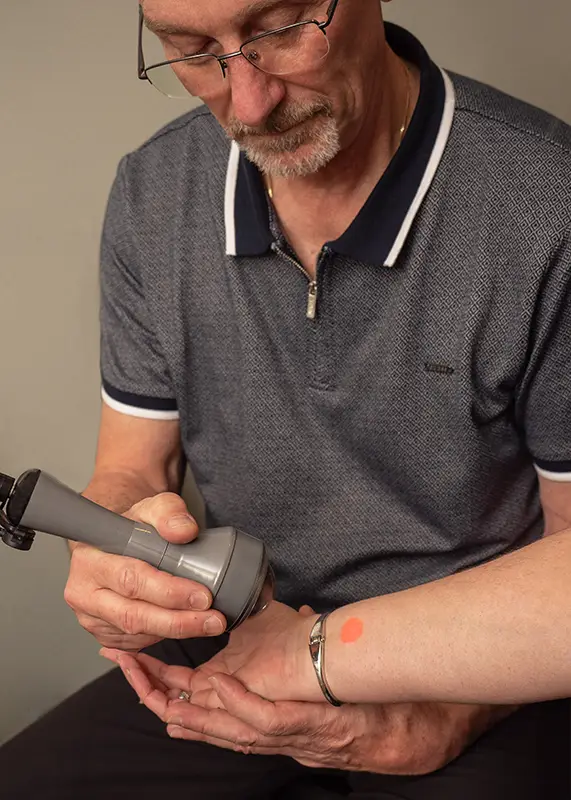
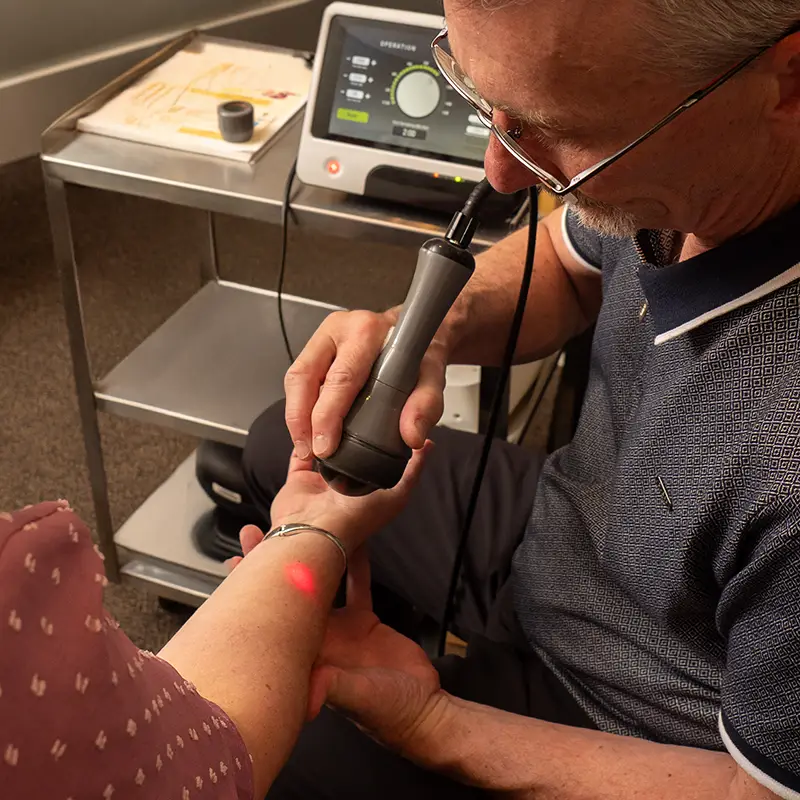
A handheld laser device is applied to the area being treated. The therapy is non-invasive and does not involve injections or incisions.
Many patients feel little to no sensation during treatment. Some may notice a mild warming feeling in the area.

Deep Tissue Laser Therapy is not meant to stand on its own. When it has a useful role, Dr. Crokin may combine it with other forms of care based on what your evaluation shows. Different parts of a problem may need different kinds of attention.
What happened? What are you feeling? What activities have become harder? Your experience helps provide the context for the evaluation.
Dr. Crokin looks at the areas that are painful, sensitive, irritated, or not functioning the way they should.
How your body moves can provide important information about what may be contributing to the problem and where care should be focused.
BeWell takes a neurology-based approach, considering how the nervous system is functioning alongside the musculoskeletal findings.
Some sports impacts produce more than a local strain or sprain. If you have persistent dizziness, unusual balance problems, brain fog, visual or motion sensitivity, altered sensation, or a broader group of symptoms after an impact, a Post-Trauma Recovery evaluation may be more relevant. Learn About Post-Trauma Recovery
No. Determining which muscles, tendons, ligaments, joints, or other soft tissues are involved is part of the evaluation.
Many patients feel little to no sensation during treatment. Some may notice a mild warming feeling in the area being treated.
No. A handheld laser device is applied to the area being treated. The therapy is non-invasive and does not involve injections or incisions.
Only when Dr. Crokin believes it has an appropriate role. Understanding how laser therapy works does not mean it is the right treatment for every problem, and another approach may make more sense in other situations.
Care may involve muscles, tendons, ligaments, joints, and surrounding soft tissues. Common areas may include the shoulders, hips, knees, and feet.
It is not meant to stand on its own. When it has a useful role, Dr. Crokin may combine it with spinal adjustments, massage and soft-tissue care, or movement and rehabilitation, based on what your evaluation shows.