
Opens in a new tab

BeWell Chiropractic | Therapies

Roller Table Therapy in Tigard, OR

Gentle, rhythmic spinal movement that can add comfort to your care.
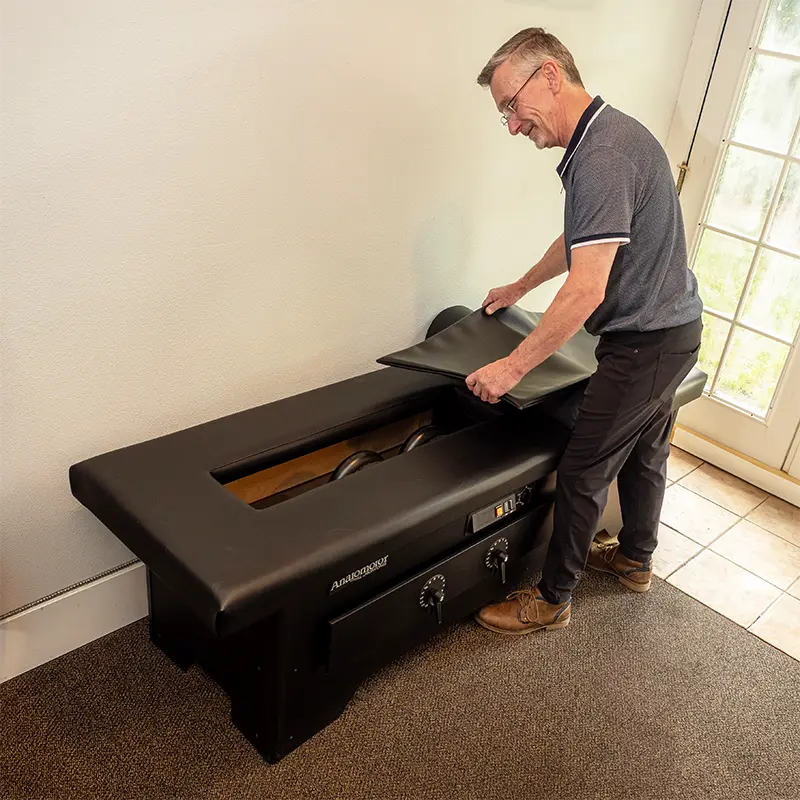
BeWell Chiropractic Roller Table Therapy Setup

What Is Roller Table Therapy?

A roller table, sometimes called an intersegmental traction table, has a set of motorized rollers beneath a padded surface. As you rest on the table, the rollers move slowly along your back in a repeating pattern.

The table creates passive spinal motion without requiring you to stretch, brace, or perform an exercise. The rollers also make broad contact with the muscles and other soft tissues along the back.

A Deliberate Progression

  • Rhythmic movement along the spine
  • Broad pressure and motion through the surrounding soft tissues
  • Consistent sensory input from the back as the rollers move
  • An adjustable experience that can be changed for comfort
The purpose is straightforward: give your back a comfortable source of movement while you relax on the table.

Why Gentle Spinal Movement Can Be Useful

When your back feels tight, stiff, or guarded, another source of movement can feel very different from sitting still or protecting the area. Roller table therapy gives the spine and surrounding tissues a slow, repeating motion while you remain relaxed.

 That experience may help ease the sense of muscle tension and make movement feel more comfortable for some patients. The rolling pressure also creates ongoing sensory input from the back, which fits BeWell’s broader attention to how movement and sensation contribute to function.

 The roller table isn’t used to diagnose the cause of a symptom, and BeWell doesn’t present it as a stand-alone answer for pain or injury. Its value is more modest: it gives Dr. Crokin another way to add passive motion and relaxation when those things are useful.
Its role is comfort and movement, not diagnosis.

The Roller Table is the "Cherry on Top"

Dr. Crokin’s explanation is simple: the roller table is the “cherry on top.” Many patients enjoy the rhythmic motion, it can feel good, and it adds a little extra value without making the visit more complicated.

 There’s nothing mandatory about it. Some patients love the table. Others don’t particularly enjoy it. Either response is fine. BeWell doesn’t build care around a piece of equipment.

The roller table is one optional tool Dr. Crokin can use when it adds comfort or useful movement to the visit.

What To Expect

What Roller Table Therapy Feels Like

You’ll lie fully clothed on the padded table while the rollers move slowly beneath your back. The motion generally travels from the lower back upward in a smooth, repeating pattern.

People often describe the sensation as relaxing, rhythmic, and gently loosening. It can feel a little like a moving pressure massage along the back, although it isn’t the same as hands-on massage therapy.

Step 1

Get comfortable on the padded table.

Step 2

Combined Challenges

Step 3

The setting can be adjusted to make the pressure more comfortable.

Step 4

Tell us if something feels too strong or simply isn’t enjoyable.

Not everyone likes the same amount of pressure or movement.

Your comfort matters more than finishing a preset routine.

How It Fits Into Your BeWell Care Plan

Roller table therapy is considered in the context of the rest of your care. Dr. Crokin may use it before or after another part of the visit depending on what he wants to accomplish that day.

Your evaluation determines what deserves attention. Depending on the findings, care may include chiropractic adjustments, massage or other soft-tissue work, movement-based rehabilitation, Class IV laser therapy, electrical stimulation, or roller table therapy. There’s no requirement that every visit use the same combination. The plan can change as your needs and findings change.

When Roller Table Therapy May Be a Good Fit

Roller table therapy may be worth considering when the main need is a comfortable source of passive movement rather than another intensive treatment.

Dr. Crokin may consider it when you’re dealing with

Muscle tightness or a back that feels tense
Stiffness or reduced ease of movement
A guarded feeling after physical stress or discomfort
Difficulty relaxing because your back feels wound up
A preference for a gentle, passive way to loosen up during the visit
These situations don’t automatically mean you need roller table therapy. The same symptom can come from different factors, and the table doesn’t replace the evaluation that helps Dr. Crokin decide what actually belongs in your care. If you’re recovering from an injury or dealing with persistent symptoms, the appropriate treatment approach should be based on your broader findings rather than the presence of stiffness or tension alone.

Frequently Asked Questions

No. The table creates moving pressure beneath your back, so some people compare the sensation to a gentle massage. Massage therapy is hands-on soft-tissue treatment performed by a massage therapist.

No. BeWell uses the roller table as an optional supportive therapy. Whether an adjustment or another therapy belongs in your care is determined separately from whether you use the table.

No. Dr. Crokin is very clear that there’s nothing mandatory about it. If you enjoy it and it fits the visit, it can be included. If you don’t like it, it can be skipped.

Yes. BeWell may use it at different points in a visit depending on what’s being done that day. There isn’t one required sequence for every patient.

Speak up. The setting can be adjusted for comfort, and the table doesn’t need to be used if the experience isn’t right for you.

The roller table isn’t used as a stand-alone solution or diagnostic tool. Dr. Crokin first evaluates the factors that may be contributing to your symptoms, then decides which forms of care are appropriate.

Find Out What Fits Your Care

If you’ve been dealing with tension, stiffness, pain, or difficulty moving, the most useful next step is to understand what may be contributing.

At BeWell Chiropractic, you’ll share what has been happening and Dr. Crokin will complete a focused evaluation based on your symptoms and goals. He’ll explain what he finds and recommend care that makes sense for those findings. Your care can include the roller table when it makes sense, or move in another direction when a different approach is more appropriate.
BeWell Chiropractic | 12395 SW 68th Ave, Ste A | Tigard, OR 97223